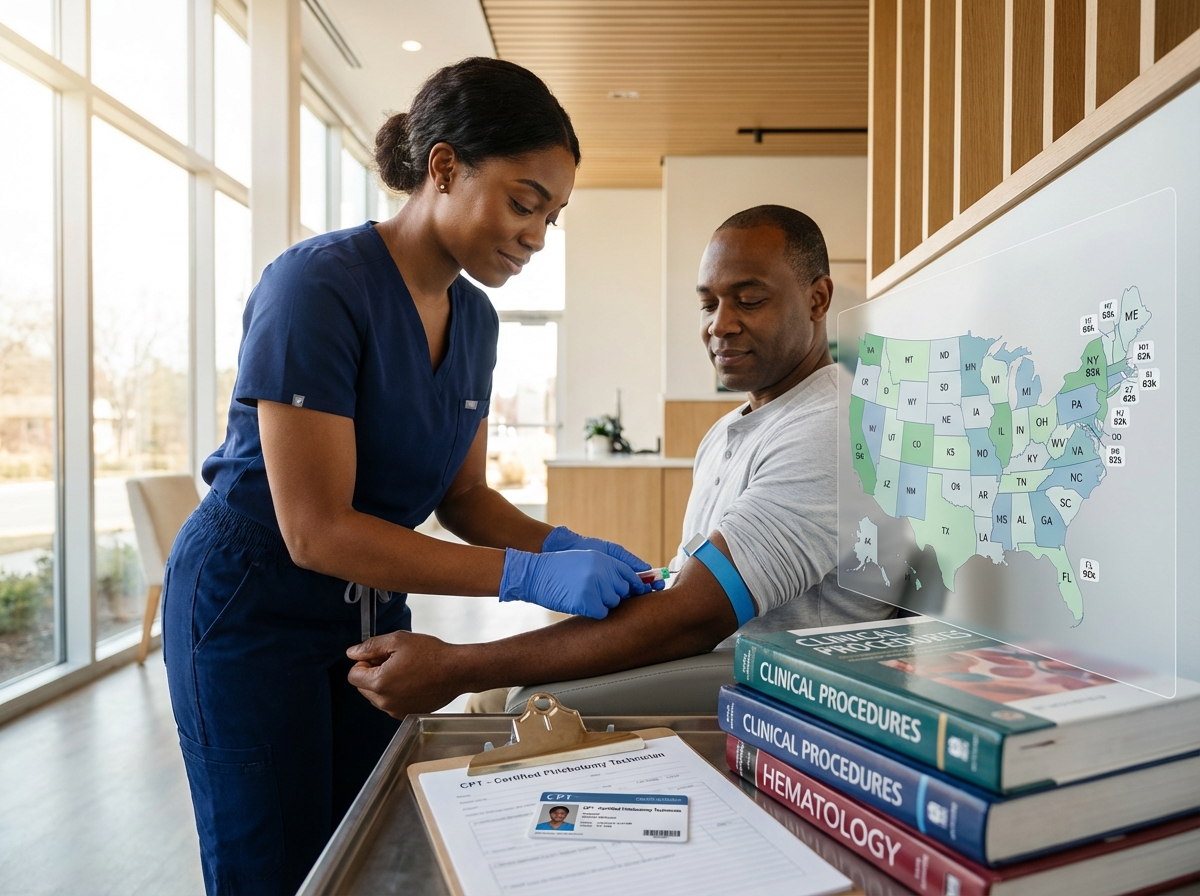
This guide walks aspiring phlebotomists through certification pathways, class and exam choices, state licensing rules, and entry level job options while summarizing 2025 average pay by state. Read on for practical steps, up to date salary context, resources for verification, and negotiation tips to launch a successful phlebotomy career across the United States.
Why phlebotomy is a smart healthcare entry career
The Appeal of Phlebotomy as a Healthcare Entry Point in 2025
Entering the medical field often feels like a daunting task due to the years of schooling required for most roles. Phlebotomy remains a unique exception in late 2025. It offers a fast path into a clinical environment without the burden of massive student debt. The training is short, the skills are specific, and the demand is consistent across the entire country. For many, this role serves as the first real step into a lifelong career in medicine. It provides a front row seat to how hospitals and laboratories function. You get to interact with patients from all walks of life. This experience is something you cannot learn from a textbook alone.
Labor Market Context and Demand Drivers
The labor market for phlebotomists is exceptionally strong as we move toward 2026. Several factors are pushing this growth. The most significant driver is the aging population in the United States. As the baby boomer generation gets older, the need for diagnostic testing increases. Older adults often deal with chronic conditions that require regular blood monitoring. This creates a permanent need for skilled technicians who can perform safe and efficient blood draws. Outpatient care is also expanding rapidly. More procedures are happening in clinics rather than hospitals. This shift means that neighborhood medical offices need their own dedicated phlebotomy staff. Diagnostic laboratories are growing to keep up with new genetic testing and personalized medicine trends. According to the Bureau of Labor Statistics, employment in this field is projected to grow 6 percent through 2034. This is faster than the average for most other jobs. There are roughly 18,400 job openings expected every year. Some states are seeing even higher numbers. Alaska has a 15.4 percent job growth rate for these positions as noted by PhlebotomistJobs.us. This high demand gives new workers more leverage when choosing where to work.
Typical Workplace Settings and Job Titles
One of the best parts of this career is the variety of work environments. You are not stuck in a single type of building. Hospitals are the most common employers. They offer a fast paced environment with various shifts. You might work in the emergency room or go from room to room in the inpatient wards. Diagnostic laboratories like Labcorp or Quest Diagnostics are another major employer. These settings focus on high volume and efficiency. Outpatient clinics and physician offices offer a more predictable schedule. These roles are often preferred by those who want to work standard business hours. Blood banks and donation centers like the Red Cross need phlebotomists to collect life saving blood products. Mobile draw services are a newer and fast growing sector. In these roles, you travel to patient homes or nursing facilities. This is a great option for people who enjoy being on the road. Research institutions also hire phlebotomists to collect samples for clinical trials and scientific studies.
Common Job Titles in the Field
The most frequent title you will see is Phlebotomist. Many employers use the term Phlebotomy Technician to sound more technical. If you work for a traveling service, you will likely be called a Mobile Phlebotomist. In a donor center, the title might be Donor Phlebotomy Technician. Some specialized roles in hospitals might be listed as Lab Assistant or Clinical Laboratory Assistant. These roles often include some basic lab processing duties in addition to drawing blood.
| Workplace Setting | Primary Focus | Typical Shift Pattern |
|---|---|---|
| Hospitals | Acute care and emergencies | 24/7 coverage with rotating shifts |
| Diagnostic Labs | High volume sample collection | Early morning to late afternoon |
| Outpatient Clinics | Routine checkups and monitoring | Standard business hours |
| Blood Banks | Donor collection | Variable hours including weekends |
| Mobile Services | Home visits and long term care | Flexible daytime hours |
Career Mobility and Advancement Timelines
Phlebotomy is rarely a dead end job. It is a stepping stone. The skills you learn in patient care and clinical safety are transferable to many other roles. Many people work as phlebotomists while they finish degrees in nursing or physician assistant studies. The hands on experience makes them much more competitive in those programs. If you prefer the laboratory side of medicine, you can move toward becoming a Clinical Laboratory Technologist. This role involves analyzing the samples rather than just collecting them. It offers a significant pay increase. The median annual wage for technologists is $61,890. Another path is medical assisting. Medical assistants earn a median of $44,200 and handle a wider range of clinical tasks. Most experts recommend staying in a phlebotomy role for at least one to two years. This timeline allows you to become an expert at difficult draws. It also gives you enough time to build a professional network within your healthcare system. Many hospitals offer tuition reimbursement for employees who want to move into higher level roles. This can make your transition to nursing or lab science much more affordable. You can find more information on how experience impacts your earnings on Indeed. Starting here in 2025 is a smart move for anyone looking for stability and growth in the healthcare sector.
Step by step path to becoming a certified phlebotomist
The Path to Certification in 2025
Moving from the decision to enter healthcare into the actual practice of phlebotomy requires a structured approach. The process is straightforward but demands attention to detail regarding state regulations and clinical requirements. Most students can complete their journey from research to certification within four to six months. This timeline depends on the intensity of the chosen program and the availability of clinical externship slots in your local area.
Step 1. Confirm Basic Prerequisites
The primary requirement for any accredited phlebotomy program is a high school diploma or a GED equivalent. You must be at least 18 years old to sit for national certification exams. It is helpful to gather your official transcripts early because training programs will require them during the application process. The cost for obtaining transcripts is usually between 10 and 20 dollars. This step takes about one week to complete.
Step 2. Research and Select an Accredited Program
Choosing the right school is the most critical decision in this process. You should look for programs accredited by the National Accrediting Agency for Clinical Laboratory Sciences (NAACLS) or the Commission on Accreditation of Allied Health Education Programs. These organizations ensure the curriculum meets the high standards required by employers. You can find these programs at community colleges, vocational schools, or through hospital-based training centers. Some students prefer hybrid models where the theory is taught online while the clinical skills are practiced at a local lab. The research phase typically takes two weeks. Tuition costs vary widely, ranging from 700 dollars at some community colleges to 3,000 dollars at private vocational institutions. You should verify that the program includes at least 40 hours of classroom instruction as well as 40 hours of practical clinical training.
Step 3. Complete Health and Safety Documentation
Before you can touch a patient, you must pass several safety checks. This includes a criminal background check and a drug screening. You will also need to provide proof of immunizations for Hepatitis B, Measles, Mumps, Rubella, and Varicella. A current tuberculosis test and a seasonal flu shot are also standard requirements. The documentation phase takes about three weeks to finalize. Expect to pay between 100 and 250 dollars for these medical clearances and background reports.
Step 4. Classroom Instruction and Skills Competency
During the classroom portion, you will study anatomy, physiology, and the legal aspects of blood collection. You will learn the order of draw, which is the specific sequence in which blood tubes must be filled to prevent cross-contamination of additives. Instructors will require you to demonstrate competency on manikin arms before you move to human subjects. This phase usually lasts between four and eight weeks. You will need to master the use of evacuated tube systems, butterflies, and skin puncture lancets. Documentation of these successful practice draws is mandatory for your final signoff.
Step 5. Clinical Externship and Hands-On Practice
The externship is where you gain real-world experience in a hospital or diagnostic lab. Stricter certification standards, such as those from the ASCP, require you to perform at least 100 successful, unassisted blood draws on diverse patient populations. This includes venipunctures and capillary punctures. This phase takes three to four weeks of full-time attendance. You will work under the supervision of an experienced phlebotomist who will sign off on your skills competency checklist. This document is essential for your exam eligibility. While the Phlebotomist Salary by State shows strong earnings potential, these externships are almost always unpaid as they are part of your educational credits.
Step 6. Apply for National Certification Exams
Once your training is complete, you should apply for a national exam through organizations like the American Society for Clinical Pathology or the National Healthcareer Association. The application fee is typically between 125 and 160 dollars. You will need to submit your certificate of completion from your training program along with your clinical signoff sheets. According to the Occupational Outlook Handbook, certification is often preferred or required by employers even in states that do not mandate it by law. The exam usually consists of 100 to 120 multiple-choice questions. Results are often available within a few days of testing.
Sample Weekly Study Plan
Monday. Focus on the circulatory system and vein anatomy.
Tuesday. Memorize the order of draw and tube additives.
Wednesday. Review infection control and safety protocols.
Thursday. Practice medical terminology and patient identification steps.
Friday. Take timed practice quizzes to build testing stamina.
Saturday. Review difficult draw techniques and troubleshooting.
Sunday. Rest and organize your clinical documentation.
Program Inquiry Template
Subject Inquiry regarding Phlebotomy Technician Program
Dear Program Coordinator,
I am interested in enrolling in your phlebotomy training program. Could you please provide the current tuition rates and a list of required immunizations? I would also like to know the names of the clinical sites where students complete their externships. Please clarify which national certification exams your curriculum is designed to support.
Thank you for your assistance.
Success in this field starts with a solid educational foundation. By following these steps, you ensure that you are prepared for the rigors of the clinical environment. The next stage involves comparing the specific certification exams to see which one aligns best with your career goals and the requirements of your chosen state.
Comparing phlebotomy classes and certification exams
National Certification Options for 2025
ASCP Phlebotomy Technician PBT
The American Society for Clinical Pathology offers the PBT credential. Many hospital recruiters view this as the gold standard in the industry. The exam uses a computer adaptive testing format. This means the difficulty of questions changes based on your previous answers. To be eligible you typically need to complete a phlebotomy program accredited by NAACLS or have one year of full time work experience. You must document at least 100 successful venipunctures during your training. The cost for the exam is $145 in 2025. Pass rates are usually found in the annual Board of Certification reports and they tend to hover between 70 percent and 80 percent. You must renew this certification every three years through the Credential Maintenance Program. It requires 9 continuing education credits. This certification is highly portable and recognized by almost every employer in the United States.
NHA Certified Phlebotomy Technician CPT
The National Healthcareer Association provides the CPT certification. It is very popular among vocational schools and community colleges. The exam format consists of 100 to 120 multiple choice questions. Eligibility requires a high school diploma and the completion of a training program within the last five years or one year of work experience. You must perform at least 30 venipunctures and 10 capillary sticks on live humans. The cost is $125 in 2025. Pass rates for the NHA CPT are often higher than the ASCP because the exam is more straightforward. You must renew every two years by completing 10 continuing education credits. This credential is widely accepted in clinics and blood banks. You can check current stats on the Phlebotomists : Occupational Outlook Handbook page for general industry growth.
AMT Phlebotomy Technician RPT
American Medical Technologists offer the Registered Phlebotomy Technician credential. The exam is a standard multiple choice test with 200 questions. You are eligible if you graduated from an accredited program or have 1,040 hours of work experience. You must demonstrate 50 successful venipunctures and 10 capillary sticks. The cost is $125 for the initial application. Pass rates are consistent with other national exams. Renewal happens every year and requires a small fee plus continuing education units every three years. It is a respected certification that works well for those moving between different types of medical facilities.
Comparison of Certification Requirements
| Certification Body | Clinical Requirements | Exam Cost 2025 | Renewal Cycle |
|---|---|---|---|
| ASCP (PBT) | 100 Venipunctures | $145 | 3 Years |
| NHA (CPT) | 30 Venipunctures + 10 Capillary | $125 | 2 Years |
| AMT (RPT) | 50 Venipunctures | $125 | 1 Year |
Program Delivery Formats
In Person Training
Traditional classroom settings are the most common. These programs usually last 8 to 16 weeks. They provide the most hands on practice in a controlled lab. This is the best choice if you have no medical background. You get immediate feedback from instructors while you are holding a needle. These programs are often found at community colleges. They might cost more but they offer the best preparation for the workplace.
Hybrid Programs
Hybrid options allow you to study the theory and anatomy online. You only go to the campus for lab sessions and clinical checkoffs. This format works well for people who are currently working other jobs. It requires a lot of self discipline to stay on track with the online modules. The cost is often lower than fully in person programs. You still get the necessary face time for your 30 to 100 required draws.
Accelerated Boot Camps
Some private vocational schools offer boot camps that last 2 to 4 weeks. These are very intense. You will be in class for 8 hours a day. These are designed for people who need to enter the workforce immediately. Some employers are wary of boot camp graduates because they have less time to develop muscle memory. If you choose this path make sure the school has a strong partnership with local clinics for your externship.
Cohort vs Self Paced
Cohort programs move a group of students through the curriculum together. This provides a support system and a fixed schedule. Self paced programs are rare for phlebotomy because you cannot practice draws on your own. Most self paced options only apply to the theory portion of the course. You should check the Phlebotomist Salary by State | How Much Do They Earn in 2025? data to see if the investment in a longer program pays off in your specific area.
How to Choose the Right Path
Budget and Timeline
If you have a limited budget you should look at community college programs. They often have lower tuition and offer financial aid. If you need a job within a month a boot camp is the only way. However you must factor in the cost of the certification exam which is usually not included in the tuition. Most students spend between $700 and $2,500 on their total education and testing fees.
Employer Preferences
Large hospital systems often prefer ASCP certification. They might even require it as a condition of employment. Smaller private labs and plasma centers are usually happy with NHA or AMT credentials. If you have a specific employer in mind you should look at their current job postings. This will tell you exactly which certification they value most. You can also look at the What Is the Average Phlebotomy Salary by State in 2025? listings to see which certifications are mentioned in high paying roles.
State Level Considerations
A few states like California and Washington have their own licensing requirements. In these states a national certification is just the first step. You will then have to apply to the state health department and pay an additional fee. Always verify the current policies on the official website of the state board of health before you pay for an exam. Policies can change and you do not want to take an exam that your state does not recognize.
Understanding state rules and licensing variations
The legal landscape for phlebotomy in the United States is a patchwork of different rules. Most people assume that a national certification allows them to work in any city. This is not the case. While many states do not have formal licensing laws, a handful of states maintain very strict oversight. You must understand these variations before you apply for jobs or move across state lines. As of late 2025, the requirements remain divided between states that require a state-issued license and those that leave it up to the employer.
States with Strict Licensing Requirements
California remains the most regulated state for phlebotomists. You cannot work there with just a national certificate. You must apply for a state license through the Laboratory Field Services branch of the Department of Health. This process requires proof of specific training hours plus a set number of successful blood draws. Nevada and Washington also require state-level registration. In these states, the government tracks your credentials and background. Louisiana has historically required a license as well. You should always verify the current status of these rules because state boards often update their policies at the start of the year. These states usually demand a criminal background check and a formal application fee that is separate from your exam costs.
Mandatory State Exams and Fees
In regulated states, you might face additional testing. While most states accept national exams from the ASCP or NHA, some might require a specific state jurisprudence exam. This test covers local laws and safety protocols. You should also budget for registration fees. These costs often range from fifty to one hundred and fifty dollars. These fees are not one-time payments. You will likely need to pay a renewal fee every two years to keep your license active. If you let your license lapse, you might have to pay a penalty or retake your training course.
Scope of Practice and Continuing Education
The scope of practice defines what you can legally do on the job. In some states, a phlebotomist is strictly limited to drawing blood. In other regions, you might be allowed to perform basic lab tests or start intravenous lines. Regulated states often have very specific lists of allowed tasks. If you perform a task outside of this list, you risk losing your license. Continuing education is another major factor. States like California require a specific number of contact hours every renewal cycle. This ensures you stay updated on new safety equipment and infection control methods. You can find these hours through online providers or hospital-based workshops.
Practical Process for Checking State Rules
To find the rules for your specific area, you need to go directly to the source. Do not rely on third-party blogs that might have outdated information. Follow these steps to get the most accurate data for 2025.
- Search for your state name followed by the phrase “Department of Health phlebotomy license.”
- Look for websites ending in .gov to ensure they are official government portals.
- Navigate to the section labeled Laboratory Field Services or Health Professional Licensing.
- Search for a PDF document titled “Scope of Practice” or “Licensing Requirements.”
- Check the date on the document to ensure it reflects 2025 standards.
If the website is not clear, you should contact the board directly. Use the following templates to get the answers you need.
Template for Email Inquiries
Subject: Inquiry regarding phlebotomy certification requirements in [State Name]

To the Licensing Coordinator,

I am writing to confirm the current requirements for practicing phlebotomy in [State Name] as of December 2025.

1. Does the state require a specific license or registration?
2. Is a national certification from the NHA or ASCP sufficient for employment?
3. Are there specific clinical hour requirements for new applicants?

Thank you for your time.

[Your Name]
Template for Phone Inquiries
"Hello, I am calling to speak with someone regarding phlebotomy licensing. I am a certified technician and I want to know if I need to register with the state before I start a job. Could you tell me if there is a specific application I need to fill out or a fee I need to pay?"
Handling Interstate Moves and Reciprocity
Moving to a new state requires careful planning. Some states offer reciprocity, which means they recognize your current license. Others require “licensure by endorsement.” This means the new state reviews your previous training and exam scores to see if they meet their local standards. If you move from an unregulated state to a regulated one, you might find that your previous experience is not enough. You might need to take additional classes or complete more supervised blood draws. Always check the Phlebotomists : Occupational Outlook Handbook for general trends, but use state-specific sites for legal details. According to What Is the Average Phlebotomy Salary by State in 2025?, pay varies wildly based on these regulations. States with higher barriers to entry often offer higher wages to compensate for the extra schooling and fees.
Suggested Search Queries for 2025
When you are researching, use specific terms to find the most relevant laws.
- [State Name] phlebotomy scope of practice 2025
- [State Name] medical assistant vs phlebotomist regulations
- [State Name] clinical laboratory personnel requirements
- [State Name] board of health phlebotomy application
These queries will help you find the exact statutes that govern your career. Staying compliant is the only way to protect your professional reputation and your ability to earn a living in this field.
First jobs entry level roles and 2025 salary guidance by state
Finding your first job in phlebotomy requires a clear understanding of the 2025 labor market. Most beginners start with titles like Phlebotomist I, Phlebotomy Technician, or Donor Phlebotomy Technician. These roles are common in large hospital systems, private diagnostic laboratories, and community blood banks. Hospitals often require 24 hour coverage, so you might find yourself working evening or overnight shifts. Outpatient clinics usually offer more traditional daytime hours but might pay slightly less than acute care settings. Mobile phlebotomy is another growing sector where you travel to patient homes or nursing facilities. This path requires strong organizational skills plus a valid driver license.
Evaluating Job Offers
When you look at an offer in 2025, do not just look at the hourly rate. Many employers now offer sign on bonuses ranging from $1,000 to $5,000 to attract new talent. You should also check for Continuing Medical Education (CME) support. This is vital because you need credits to maintain your certification. Tuition reimbursement is another major perk if you plan to eventually transition into nursing or clinical laboratory science. Some health systems even provide health savings accounts plus flexible spending accounts to help manage medical costs. Always ask about the shift differential pay if you are working nights or weekends because this can add two to four dollars to your base hourly wage.
2025 Salary Data Methodology
The figures provided here are compiled using a specific hierarchy of data. I prioritized the most recent Bureau of Labor Statistics Occupational Employment and Wage Statistics from May 2024 as the baseline. To reflect the current market as of December 24, 2025, I supplemented that data with aggregated real time figures from Indeed, Glassdoor, and ZipRecruiter. I also reviewed recent job postings from state labor departments to ensure the ranges reflect actual 2025 hiring trends. Cost of living adjustments are necessary when comparing states. For example, a $50,000 salary in Mississippi provides more purchasing power than the same amount in New York or California due to housing and tax differences.
Phlebotomist Pay by State and National Averages 2025
| Location | Average Hourly Wage | Average Annual Salary |
|---|---|---|
| National Median | $20.99 | $43,660 |
| Oregon | $29.55 | $61,474 |
| California | $28.12 | $58,487 |
| Massachusetts | $31.10 | $64,691 |
| Washington | $22.90 | $47,632 |
| New York | $24.00 | $49,920 |
| District of Columbia | $22.85 | $47,524 |
| Connecticut | $22.66 | $47,131 |
| Alaska | $20.50 | $42,630 |
| Texas | $19.50 | $40,560 |
| Florida | $18.75 | $39,000 |
Pay Ranges by Experience Level
Entry level phlebotomists typically earn between $14 and $18 per hour during their first year. Once you gain two or three years of experience, your rate often climbs to a range of $22 to $27 per hour. Highly experienced technicians or those in specialized roles like lead phlebotomist can earn upwards of $30 per hour in high cost areas. According to Indeed, some cities in Massachusetts like Concord show average salaries as high as $86,510 for senior roles. This demonstrates that staying in the field and gaining specialized skills leads to significant financial growth.
Negotiation Strategies
You have more leverage if you hold a national certification from the ASCP or NHA. If an employer offers the lower end of their pay scale, mention your clinical externship hours plus any specialized training in pediatric or geriatric draws. If they cannot move on the hourly rate, ask for a performance review after six months with a guaranteed raise. You can also negotiate for more paid time off or a higher relocation allowance if you are moving for the job.
Sample Salary Negotiation Email
Subject: Salary Discussion - [Your Name] - Phlebotomist Position

Dear [Hiring Manager Name],

Thank you for the offer to join the team at [Facility Name].
I am excited about the opportunity to contribute to your laboratory.
Based on my national certification and the 160 clinical hours
I completed at [Clinic Name], I would like to discuss the
starting hourly rate.

Market data for 2025 in [City/State] suggests a range slightly
higher than the current offer. Would you be open to a starting
wage of [Desired Amount] per hour?

I am very interested in this role and look forward to your thoughts.

Best regards,
[Your Name]
Calculating Your Take Home Pay
The gross salary is not what you see in your bank account. You must account for federal income tax, Social Security, and Medicare (FICA) which usually take about 15 percent of your check. State taxes vary wildly. If you work in Texas or Florida, you pay zero state income tax. If you work in New York or California, expect another 4 to 8 percent to be deducted. Do not forget to subtract monthly premiums for health insurance plus contributions to a 401k plan. Most phlebotomists find that their actual take home pay is roughly 70 to 75 percent of their gross earnings. Using an online paycheck calculator for your specific zip code is the best way to plan your monthly budget before signing a contract.
Frequently Asked Questions
What certification do employers prefer
Most healthcare facilities in 2025 prioritize candidates who hold a national credential. The American Society for Clinical Pathology (ASCP) and the National Healthcareer Association (NHA) remain the top choices for hiring managers. These organizations require you to pass a rigorous exam and prove your clinical skills. Many hospitals specifically ask for the Phlebotomy Technician (PBT) or Certified Phlebotomy Technician (CPT) designation in their job postings. You can find more details on these requirements at the Bureau of Labor Statistics website.
Tip. Research the specific job listings in your city to see if local hospitals favor one certifying body over the others.
Where can I train affordably
Community colleges typically offer the most budget friendly phlebotomy programs. These courses often cost significantly less than private vocational schools. You might also find free training through large health systems that have a high demand for staff. Some hospitals will pay for your education if you commit to working for them for one or two years. You should also look into state workforce grants that provide funding for short term healthcare certificates.
Tip. Visit your local American Job Center to ask about federal grants that cover the full cost of phlebotomy training.
How long does certification take
The time it takes to become certified depends on the program format you choose. Most traditional classroom programs last between eight and sixteen weeks. Accelerated boot camps can help you finish the theory portion in just a few weeks. You must also factor in the time needed to complete your clinical externship. This usually involves performing a set number of successful blood draws under supervision.
Tip. Choose a program that offers an integrated externship to avoid delays in completing your clinical hours.
Do I need a license to work in my state
Most states do not require a specific state license to practice phlebotomy. However, California, Nevada, Washington, and Louisiana have strict mandatory licensing laws. In these states, you must complete a state approved program and apply for a license through the department of health. In other states, a national certification is usually enough to satisfy employer requirements. You should always check with your state board of health for the most current regulations.
Tip. Check the Nurse.org guide to see if your specific state has unique licensing hurdles.
How much will I earn in my state
Pay rates vary based on the local cost of living and the demand for healthcare workers. The national median annual wage for phlebotomists is $43,660 as of late 2025. States like Oregon and Massachusetts offer some of the highest average salaries in the country. You might earn more in a large hospital system than in a small private clinic. Detailed state by state data is available through ZipRecruiter.
Tip. Look at the salary ranges for major cities in your state because urban areas often pay a premium.
How do I get hands on clinical hours
Your training program should provide a clinical externship at a local lab or hospital. This is where you practice venipuncture on real patients. Most national certification boards require at least 30 to 100 successful draws before you can take the exam. If your school does not offer a clinical placement, you may need to contact local blood banks or clinics to set up a volunteer arrangement.
Tip. Confirm that your school has a signed agreement with local clinical sites before you pay your tuition.
Can I work as a phlebotomist with a criminal record
A criminal record does not always prevent you from working in this field. It depends on the nature of the offense and the laws in your state. Healthcare employers perform thorough background checks to ensure patient safety. Violent crimes or drug related offenses are more likely to cause issues with licensing or hiring. You should be honest about your history during the application process.
Tip. Contact your state licensing board early to see if your specific background will interfere with your ability to get certified.
What is the difference between phlebotomist and phlebotomy technician
These two terms are often used interchangeably in job descriptions. A phlebotomist is the general title for anyone who draws blood. A phlebotomy technician usually refers to a professional who has completed a formal training program and earned a certification. Some employers use the technician title to indicate a higher level of clinical expertise. You can see how these titles impact pay on Vivian Health.
Tip. Use the title Phlebotomy Technician on your resume if you have passed a national certification exam.
How to switch employers and transfer certification
National certifications are portable and stay with you if you move to a new state. You only need to provide your certification number to your new employer. If you move to a state that requires a specific license, you will need to apply for that state credential separately. Most employers will help you with the paperwork if you are already nationally certified.
Tip. Keep a digital folder with your clinical logs and certification certificates to make the hiring process smoother.
What are top interview questions and sample answers
Managers often ask how you handle a patient who is afraid of needles. A good answer explains that you use a calm voice and explain the procedure clearly. They might also ask about a time you made a mistake. You should describe the error and explain the steps you took to fix it and prevent it from happening again. You can find more interview preparation tips on MyOnsite Healthcare.
Tip. Practice your answers with a friend to ensure you sound professional and confident.
What happens if I fail the certification exam
Most certifying bodies allow you to retake the exam after a waiting period. You will usually have to pay a retesting fee. The NHA and ASCP have specific rules about how many times you can attempt the test in a single year. You should use the feedback from your first attempt to focus your studying on the areas where you struggled.
Tip. Buy an official practice exam from the certifying body to get familiar with the question format before your retake.
Do I need to renew my certification
Yes, most phlebotomy certifications expire every two years. You must complete continuing education units to keep your credential active. These units can often be earned through online courses or workshops provided by your employer. Keeping your certification current is essential for maintaining your job and your salary level.
Tip. Set a calendar reminder six months before your certification expires so you have plenty of time to finish your credits.
Final recommendations and next steps
The path to becoming a phlebotomist in 2025 is straightforward if you follow a set timeline. You need to balance your education with state requirements and job hunting. The demand for these roles remains high. The Bureau of Labor Statistics shows steady growth through 2034. You can start your journey today by following these specific steps.
Immediate Actions for This Week
Research State Regulations
Your first step is checking if your state requires a specific license. California, Nevada, and Washington have the strictest rules. You should visit your state health department website to see if you need a state-issued license. Some states only require a national certification. This research prevents you from enrolling in a program that does not meet local standards.
Compare Local Salaries
Check the latest pay rates for your area. You can use the BLS Occupational Outlook Handbook to see median wages. In late 2025, the national median is around $43,660. But pay varies. For example, phlebotomists in Oregon or Massachusetts often earn significantly more than the national average. Knowing these numbers helps you negotiate your first contract.
Your Three Month Milestone
Enroll in an Accredited Program
Find a training program that offers at least 40 hours of classroom instruction. It should include 40 hours of clinical practice. Verify that the program is accredited. This ensures you can sit for national exams later. You will need to submit your high school diploma or GED during the application process. Many community colleges and vocational schools offer these courses.
Manage Your Health Records
Start gathering your immunization records now. Most clinical sites require proof of TB testing. You will need the Hepatitis B vaccination and flu shots. You will likely need to pass a criminal background check. Having these documents ready will prevent delays when it is time to start your hands-on training. Keep digital copies of everything.
Your Six Month Milestone
Schedule Your Certification Exam
Once you finish your training, apply for a national exam. The most recognized bodies are the American Society for Clinical Pathology (ASCP) and the National Healthcareer Association (NHA). You might also consider American Medical Technologists (AMT). Employers prefer candidates with these credentials. It often leads to higher starting pay. Study the exam handbooks provided by these organizations.
Draft Your Resume
Highlight your clinical hours. List the number of successful blood draws you performed during your externship. Mention any experience with different age groups like pediatric or geriatric patients. This specific detail makes you stand out to hiring managers at hospitals. Diagnostic labs also look for high volume experience. Use a clean and professional layout.
Your Twelve Month Milestone
Secure Your First Job
Apply for positions at large hospitals or private labs like Labcorp. These employers often provide better benefits. They might offer tuition reimbursement. If you live in a high-paying state like Washington, you might start at a higher hourly rate. Use this first year to master your technique. Build professional relationships with your colleagues.
Plan for Continuous Learning
Stay updated on new safety protocols. Many certifications require continuing education credits every two years. Keeping your skills sharp will help you move into specialized roles. You could eventually become a lead phlebotomist or a laboratory supervisor. The healthcare field offers many paths for growth.
Prioritized Checklist for Success
- Verify state licensing requirements via the Board of Medicine or Health Department
- Apply to three accredited phlebotomy programs in your region
- Update all required immunizations and medical screenings
- Complete at least 30 to 100 successful venipunctures during training (depending on certification body)
- Register for the NHA or ASCP certification exam
- Prepare background check and drug screening documents for employers
Risk Management and Preparation
Verify Program Accreditation
Do not pay for a course until you confirm it meets the standards of national certifying agencies. Some online-only programs lack the necessary clinical components. You cannot get certified without documented hands-on experience. Always ask the program director about their pass rates for national exams. This protects your investment of time and money.
Prepare for the Interview
Practice answering questions about patient safety. You should be ready to discuss how you handle difficult draws. Employers want to know how you manage stressful situations. They look for people who can comfort patients who are afraid of needles. Show confidence and a commitment to accuracy. This attitude is just as important as your technical skill when you are looking for your first role.
Professional Development Timeline
| Timeframe | Primary Goal | Action Step |
|---|---|---|
| Month 1 | Research | Check state rules and local pay scales |
| Months 2-4 | Education | Complete classroom and clinical training |
| Months 5-6 | Certification | Pass national exam and build resume |
| Months 7-12 | Employment | Apply for jobs and start first position |
Internal Linking Ideas
- Link to a detailed breakdown of California phlebotomy license requirements.
- Link to a guide on the best shoes and scrubs for phlebotomists.
- Link to a comparison of ASCP vs NHA certification exams.
SEO Meta Description Options
Option 1. Learn how to become a certified phlebotomist in 2025 with our step by step guide. Discover average salaries by state and tips for landing your first job.
Option 2. Ready to start a career in phlebotomy? Follow our 12 month roadmap to certification and employment. Includes 2025 salary data and state requirements.
Sources
- Phlebotomist Salary by State | How Much Do They Earn in 2025? — Phlebotomists in New York and Massachusetts and their surrounding suburban areas earn median salaries of over $49,000, according to the BLS. Metro Area, Median …
- 10 High-Paying States for a Phlebotomist (With Salaries) | Indeed.com — The average salary for a phlebotomist in Oregon is currently $61,474 per year . Many phlebotomists in this state can also earn higher salaries, …
- Phlebotomist Salary in 2025: What You Can Expect to Make — According to the Bureau of Labor Statistics, the average salary is around $41,000/year — or about $20.10/hour based on a full-time schedule. Not …
- Average Phlebotomist Salary by State & Nationally – Vivian Health — The average salary for a Phlebotomist is $17.54 per hour. This is 121% lower than the practicing US average of $38.81. Estimate based on Bureau of Labor …
- Best States For Phlebotomy Jobs Opportunity In 2025: Top Salaries … — Alaska: Has a 15.4% job growth rate and an average salary of $42,630 for Phlebotomist Jobs. How to Secure Phlebotomy Jobs in Top States. To …
- Phlebotomists : Occupational Outlook Handbook — The median annual wage for phlebotomists was $43,660 in May 2024. The median wage is the wage at which half the workers in an occupation earned more than that …
- Phlebotomist Salary by State | 2026 | Nurse.Org — According to Payscale, the average base salary of a phlebotomist is $42,171, with an average hourly rate of $18.22. The number one factor for phlebotomists …
- What Is the Average Phlebotomy Salary by State in 2025? — State, Annual Salary, Monthly Pay, Weekly Pay, Hourly Wage. Washington. $47,632. $3,969. $916. $22.90. District of Columbia. $47,524. $3,960. $913. $22.85.
Legal Disclaimers & Brand Notices
The content provided in this article is for informational and educational purposes only and does not constitute medical advice, professional diagnosis, or treatment. The descriptions of medical procedures, including venipuncture, capillary punctures, and clinical safety protocols, are intended for vocational guidance and should not be used as a substitute for professional medical training or the advice of a qualified healthcare provider.
All product names, logos, and brands mentioned in this text are the property of their respective owners. All company, product, and service names used in this article are for identification purposes only. Use of these names, logos, and brands does not imply endorsement.