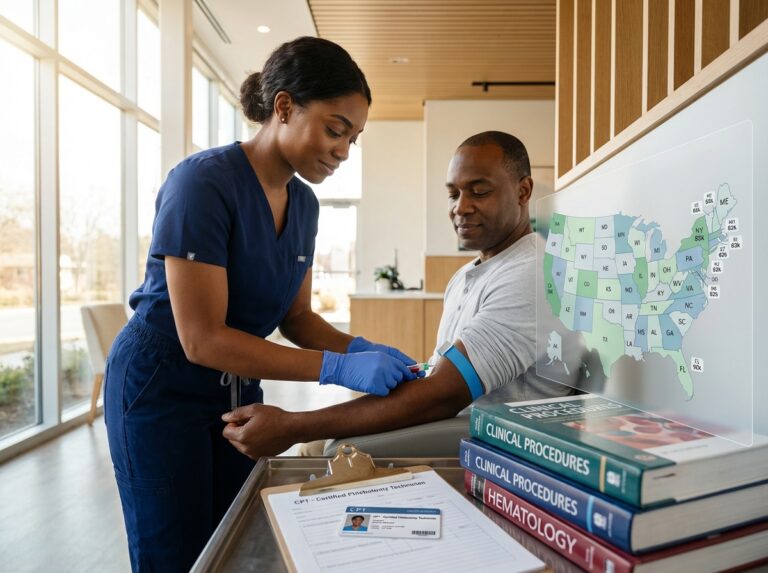
Phlebotomy remains an accessible healthcare entry point with steady demand and evolving pay patterns. This guide examines national salary averages and 2025 trends while walking you through certification routes, state rules, training options, exam choices, and practical tips to land your first phlebotomy job and maximize early-career earnings.
Current Salary Landscape and 2025 Trends
The national median annual salary for a phlebotomist in 2025 is approximately $43,660. This figure reflects a steady rise in healthcare wages over the last few years. Most full time professionals earn between $37,000 and $47,000 per year. On an hourly basis, the average rate falls between $18.00 and $22.50. Entry level workers typically start at the lower end of this spectrum, often earning between $16 and $18 per hour. Highly experienced phlebotomists or those in specialized roles can see their hourly pay reach $27 or more. This upward trend is driven by a combination of staffing shortages as well as an increased reliance on diagnostic blood work for an aging population.
Primary Drivers of Phlebotomy Wages
Geographic Location
Location remains the most significant factor in determining your pay. High demand states like California and Washington lead the nation in compensation. In California, the average hourly wage is $25.00, which results in an annual salary of about $52,000. Washington follows closely with an average of $23.50 per hour. Other top paying states include New York, Massachusetts, and Alaska. While these numbers look attractive, you should weigh them against the local cost of living. A high salary in New York City might not go as far as a moderate salary in a more affordable region. You can find more details on these variations in the phlebotomist salary insights for the current year.
Employer Type and Setting
The type of facility where you work also influences your earnings. Hospitals generally offer higher base pay along with better benefits compared to small private clinics. Outpatient laboratories and blood banks provide stable environments but might have slightly lower starting rates. A notable trend in 2025 is the growth of mobile phlebotomy. These roles often pay a premium because they require travel to patient homes or corporate offices. Mobile phlebotomists can earn $25 per hour plus mileage reimbursement. This makes it a lucrative option for those who prefer a non traditional work setting.
Experience and Certification
Your level of experience and certification directly impacts your market value. New graduates can expect to earn between $33,000 and $37,000 annually. After two to four years in the field, many see their pay rise to the $37,000 to $42,000 range. Those with five or more years of experience often command salaries above $44,000. Obtaining a national certification from a recognized body can boost your earnings by 10% to 20%. Employers view certified professionals as more reliable and skilled, which justifies the higher pay.
Total Compensation and Modern Benefits
Total compensation in 2025 includes more than just your base wage. Many healthcare organizations now offer sign on bonuses ranging from $1,000 to $5,000 to fill open positions. Benefits packages often include comprehensive health insurance, retirement plan matching, and paid time off. Tuition assistance is another valuable perk. Some employers will pay for you to continue your education in nursing or laboratory science. This provides a clear path for career advancement while you earn a living. Shift differentials are also common. Working evening, night, or weekend shifts can add $2 to $4 per hour to your base rate. Overtime pay at time and a half is frequently available due to ongoing staffing shortages.
Reliable Data Sources and Interpretation
To stay informed about current trends, you should consult reliable public data. The Bureau of Labor Statistics provides the most comprehensive national and regional data. You can also check state labor departments for localized wage reports. Industry platforms like the ERI Economic Research Institute and ZipRecruiter offer real time benchmarks based on current job postings. When you look at these reports, focus on the median wage. The median represents the middle point where half of the workers earn more and half earn less. This is usually more accurate than the average, which can be skewed by a few very high or very low earners.
Salary Reference Tables for 2025
National Salary Averages by Experience
| Experience Level | Hourly Wage Range | Annual Salary Range |
|---|---|---|
| Entry Level (0 to 1 Year) | $16.00 to $18.00 | $33,000 to $37,000 |
| Mid Level (2 to 4 Years) | $18.00 to $20.00 | $37,000 to $42,000 |
| Experienced (5+ Years) | $21.00 to $27.00 | $44,000 to $56,000 |
Top Paying States for Phlebotomists
| State | Average Hourly Pay | Average Annual Salary |
|---|---|---|
| California | $25.00 | $52,000 |
| Washington | $23.50 | $48,900 |
| New York | $22.75 | $47,000 |
| Massachusetts | $22.25 | $46,200 |
| Alaska | $21.50 | $44,700 |
Hourly to Annual Conversion Guide
Based on a standard 40 hour work week (2,080 hours per year)
| Hourly Rate | Full Time Annual Pay | Part Time Annual (20 hrs/wk) |
|---|---|---|
| $18.00 | $37,440 | $18,720 |
| $20.00 | $41,600 | $20,800 |
| $22.00 | $45,760 | $22,880 |
| $25.00 | $52,000 | $26,000 |
Practical Takeaways for Job Seekers
The highest pay is typically found in unionized states and major metropolitan areas like New York City or Los Angeles. If you want to maximize your earnings, consider working in a hospital or a mobile role. Focus on gaining certification early in your career as this makes you more competitive. The 2025 landscape shows that employers are willing to pay more for reliable, certified professionals who can handle high volume environments. Always negotiate your starting salary by highlighting your clinical hours and any specialized training you have completed. This proactive approach can help you secure a rate at the higher end of the entry level range.
Certification Pathways Classes Exams and State Rules Compared
Choosing a path to certification is the most important move you will make after deciding to enter this field. While the previous discussion covered the Phlebotomist Salary Insights for 2025, your actual paycheck depends heavily on which credentials you hold. Most hospitals and high volume labs will not even look at an application without a national certification.
National Certifying Bodies and Credentials
Three main organizations set the standard for phlebotomy in the United States. The American Society for Clinical Pathology offers the PBT(ASCP) credential, which many managers consider the gold standard. It requires a mix of formal education and documented clinical experience. The National Healthcareer Association provides the Certified Phlebotomy Technician or CPT credential. This is very common in outpatient clinics and private labs. Finally, the American Medical Technologists offers the Registered Phlebotomy Technician or RPT designation. Each of these is widely recognized, but you should check local job listings to see if a specific one is preferred in your city.
Eligibility and Clinical Requirements
You cannot just take an exam. You must prove you can actually draw blood. Most certifying bodies require at least 100 successful venipunctures. You also need to complete 10 skin punctures, which are usually finger sticks. If you are a student, these happen during your clinical rotation. If you already work in healthcare, you might qualify through on the job experience. For example, the ASCP requires a high school diploma plus the completion of an accredited training program within the last five years. The NHA requires you to have performed the 100 draws within a specific timeframe before sitting for the test.
Comparing Training Program Types
Training varies in length and cost. Short certificate courses are the fastest route. These usually last 4 to 12 weeks and cost between $1,000 and $2,000. They focus strictly on the essentials like venipuncture technique and safety. Community college programs are more thorough. These often take 6 months to a year. They cost between $2,000 and $4,000 but offer more lab time. Allied health associate degrees take two years. These are expensive, often costing over $10,000. However, they include broader medical knowledge that can help you move into laboratory tech roles later. All programs should cover infection control, basic anatomy, and specimen handling.
State Rules and Licensing Variations
The rules change depending on where you live. Most states do not have formal licensing laws. In those places, employers decide which certification they want. However, California, Nevada, Washington, Louisiana, and New York have specific regulations. California is the most rigorous. You must get a state license through the California Department of Public Health. This involves passing an approved exam and paying a state fee. Nevada and Washington also require state level registration. Always verify the current rules with your state health department before paying for a course.
Step by Step Certification Checklist
- Select a program that is accredited and includes a clinical rotation for hands on draws.
- Complete all classroom hours and reach the 100 venipuncture milestone.
- Choose a national certifying body like ASCP or NHA based on your career goals.
- Submit your application along with proof of your training and clinical hours.
- Schedule and pass the computer based certification exam.
- Maintain your status by completing 10 continuing education hours every two years.
Study Resources and Testing Tips
Preparation is the difference between passing and retaking the exam. Use the official practice tests provided by the NHA or ASCP. These mirror the actual test format. Focus on the order of draw, as this is a major part of every exam. You should also memorize the additives in each tube color. A good study schedule involves one hour of review every night for four weeks before the test. During the exam, read every word of the question. Many people fail because they miss a small detail like “except” or “not” in the prompt. The total time from starting a class to getting your certificate is usually about 3 to 4 months.
Impact on Hiring and Documentation
Being certified can increase your starting pay by 10 to 20 percent. It also makes you a safer bet for employers. When you apply for jobs, you must have a clear log of your clinical hours. Keep a signed document from your instructor that lists every successful draw you performed. This serves as proof of competency. Managers in 2025 are looking for precision and a low error rate. Showing a documented history of 100 plus successful sticks proves you are ready for the floor. This documentation is just as important as the certificate itself when you start interviewing for entry level roles.
Estimated Costs and Timelines
Budgeting for this career move is straightforward. The exam fees usually range from $125 to $145. For example, the ASCP PBT exam is $145 and the NHA CPT is $125. When you add the cost of a short certificate program, your total investment will be around $1,200 to $2,200. This is a low barrier to entry for a field with steady growth. Most students finish their training and pass their exam within a single season. Once you have that credential, you can transition immediately into the job search strategies discussed in the next section.
First Jobs Resume Interview and Salary Negotiation for Entry Level
Finding your first job as a phlebotomist requires a mix of digital searching and old fashioned networking. Most new graduates look at large hospital systems first because they have the highest volume of openings. Hospital labs provide a fast paced environment where you can master different draw types quickly. You should also look into outpatient laboratory networks like Quest Diagnostics or Labcorp. These facilities often have more predictable schedules than hospitals. Urgent care centers and primary care clinics are excellent options for those who prefer a smaller team setting.
Blood donation centers like the Red Cross are frequently hiring entry level technicians. These roles focus heavily on donor interaction and high volume draws. If you prefer working independently, mobile phlebotomy companies are growing in 2025. These employers send you to patient homes or skilled nursing facilities. Research sites and clinical trial groups also need phlebotomists to collect specific samples for studies.
Use job boards like Indeed or LinkedIn but do not stop there. Local healthcare staffing agencies often have “temp to hire” roles that are not listed on public boards. Networking is your most powerful tool. Talk to your clinical instructors because they often have ties to local lab managers. Reach out to alumni from your program who are already working in the field. Join professional LinkedIn groups for phlebotomists to see where people are getting hired in your specific city.
Phlebotomy Resume Essentials
Resume Checklist
Your resume must be clean and easy to read for automated screening tools. Include your full name and contact information at the top. List your national certification clearly with the credential acronym like PBT or CPT. Mention your specific training program and the total number of clinical hours you completed. List the types of draws you are comfortable with such as venipuncture, capillary sticks, or pediatric draws. Include any experience with Laboratory Information Systems or electronic health records. Ensure your high school diploma or equivalent is listed as it is a standard requirement.
Accomplishment Focused Examples
Avoid just listing duties. Use specific numbers to show your skill level.
- Completed 120 successful venipunctures during a clinical rotation with a 98 percent first stick success rate.
- Maintained zero specimen labeling errors across 300 draws by strictly following patient identification protocols.
- Reduced patient wait times by 15 percent through efficient tray organization and supply management.
- Received 100 percent positive feedback on patient satisfaction surveys for gentle technique with pediatric patients.
- Coordinated transport for 50 daily specimens to ensure stability and meeting laboratory turnaround times.
Interview Preparation and Model Answers
Handling Difficult Draws
The interviewer might ask how you deal with a patient who has hard to find veins. A good answer focuses on patience and technique. You could say that you always check both arms and use a warm pack to improve vein visibility. Explain that if you cannot find a suitable site after two attempts, you follow protocol by asking a senior phlebotomist to assist to ensure patient comfort and specimen integrity.
Safety and HIPAA Compliance
Safety is the top priority in any lab. If asked about safety, mention your strict adherence to Universal Precautions and the proper use of Personal Protective Equipment. For HIPAA questions, explain that you never discuss patient information in public areas. State that you ensure all computer screens are locked when you step away from your station to protect patient privacy.
Managing Anxious Patients
When asked about nervous patients, emphasize communication. Explain that you talk the patient through the process without oversharing details that might cause fear. Mention that you ask about previous fainting episodes to ensure they are in a safe position before the draw begins.
Evaluating and Negotiating Your Salary
When you receive an offer, look beyond the hourly rate. To find your annual pay, multiply the hourly wage by 2,080 if you are working full time. According to Phlebotomist Salary Insights, the average phlebotomist in the U.S. earns between $18.00 and $22.50 per hour. Entry level roles typically start between $16 and $18 per hour.
Factor in shift differentials. Working evenings, nights, or weekends can add $2 to $4 per hour to your base pay. Review the benefits package for health insurance, 401k matching, and Paid Time Off. Some employers offer tuition assistance or sign on bonuses ranging from $1,000 to $5,000 in areas with staffing shortages. Consider your commute costs and any training opportunities the employer provides.
Negotiation Script
If the offer is lower than expected, use a professional script. You might say, “I am very excited about this opportunity. Based on my national certification and the 150 successful draws I completed during my clinicals, I was hoping for a starting rate closer to $19 per hour. Is there any flexibility in the starting wage or perhaps a sign on bonus?”
Salary Expectations by Setting
Your work environment significantly impacts your pay. Hospitals often pay $18 to $20 per hour for entry level staff due to the high intensity. Outpatient labs and clinics usually range from $17 to $19 per hour. Mobile phlebotomy roles can pay $20 to $25 per hour plus travel reimbursement because they require more independence. Blood donation centers might start lower, around $16 to $17 per hour, but they offer excellent training for beginners.
Taking temporary or PRN work is a smart way to build experience. PRN stands for “pro re nata” or as needed. These roles often pay a higher hourly rate because they do not include benefits. It allows you to see how different labs operate while filling your resume with diverse experience. To boost your pay within the first year, obtain additional certifications like EKG technician or Medical Assistant. Cross training in specimen processing makes you more valuable to the lab. Always maintain high availability for evening or weekend shifts to maximize your earnings through differentials.
New Hire 30/60/90 Day Action Plan
First 30 Days
Focus on mastering the site specific protocols and Laboratory Information System. Aim for 100 percent accuracy in patient identification and specimen labeling. Build a reputation for being punctual and prepared.
60 Day Mark
Work on increasing your draw speed without sacrificing safety or patient comfort. Start taking on slightly more difficult draws under supervision. Ask for feedback from your supervisor to identify areas for improvement.
90 Day Mark
By now, you should be fully independent. Volunteer to help with inventory management or training new interns. This is the time to discuss your performance with your manager and express interest in future lead phlebotomist roles or specialized training. This proactive approach positions you for raises and promotions as you move into your second year of practice.
Measuring Your Success Over the First Year
Setting milestones helps you stay motivated as you enter the workforce. Your progress can be measured in three distinct stages.
- Three Month Milestone
By this point, you should have completed your training and passed your national certification exam. Your resume should be updated to highlight your clinical experience and your specific “first stick” success rate. - Six Month Milestone
The goal for this stage is to be settled into your first professional role. You should be comfortable with the facility protocols and have a solid handle on high volume draws. This is also the time to start looking for opportunities to work overtime or different shifts to increase your income. - Twelve Month Milestone
After a full year of experience, you are no longer considered a novice. You can expect a pay increase of roughly 10 percent. At this stage, many phlebotomists look into specialized roles like mobile services or pursue additional certifications in EKG or medical assisting to further improve their marketability.
Common Career Questions and Outlook
How often must I recertify and what are typical continuing education requirements?
You generally need to recertify every two years. This ensures that you stay current with the latest safety protocols plus medical technology. Most organizations require about 10 hours of continuing education credits for each renewal cycle. You can earn these credits through online courses, professional workshops, or attending healthcare seminars. There is also a renewal fee that typically ranges from $50 to $100. It is important to track your credits throughout the two-year period so you are not rushing at the last minute. Organizations like the ASCP or AMT provide online portals to help you manage your documentation.
How does the job outlook for 2025 look for new phlebotomists?
The job outlook is very positive. The Bureau of Labor Statistics projects a 6 percent growth in employment for phlebotomists through 2034. This means there will be about 18,400 job openings every year. Many of these openings come from the need to replace workers who transfer to other occupations or retire. Hospitals remain the largest employers, but outpatient laboratories plus physician offices are hiring at a fast pace. The rise of personalized medicine plus preventative screenings is driving this demand. If you are willing to be flexible with your location, you will likely find multiple job offers shortly after you finish your certification.
What should I do if I cannot find a job right away?
If you are struggling to find a permanent role, you should consider temporary or PRN work. PRN stands for pro re nata, which means as needed. These positions allow you to fill in for staff members who are on vacation or sick leave. It is an excellent way to get your foot in the door at a major hospital. Many PRN workers are eventually offered full-time positions because the management already knows their work ethic. You can also look into blood donation centers like the Red Cross. They often have high turnover plus a constant need for new phlebotomists. This experience looks great on a resume and helps you build the confidence you need for more complex clinical roles.
References
- Phlebotomist Salary Insights: What to Expect in 2025 – Vitali Partners — According to current healthcare wage data, the average phlebotomist in the U.S. earns between $18.00 and $22.50 per hour, or roughly $37,000– …
- Phlebotomist Salary (2025) – ERI Economic Research Institute — The average pay for a Phlebotomist is $44,154 a year and $21 an hour in the United States. The average salary range for a Phlebotomist is between $33,248 …
- Phlebotomist Salary in 2025: What You Can Expect to Make — According to the Bureau of Labor Statistics, the average salary is around $41,000/year — or about $20.10/hour based on a full-time schedule. Not …
- Phlebotomist Salary by State | How Much Do They Earn in 2025? — According to the U.S. Bureau of Labor Statistics (BLS), phlebotomists make a median salary of $43,660. In this Article. Highest Paying Cities; Factors that …
- A Phlebotomist Salary: Hourly Rate December 2025 USA — As of Dec 20, 2025, the average annual pay for an A Phlebotomist in the United States is $39,658 a year. Just in case you need a simple salary calculator, that …
- Phlebotomists : Occupational Outlook Handbook — The median annual wage for phlebotomists was $43,660 in May 2024. Job Outlook. Employment of phlebotomists is projected to grow 6 percent from 2024 to 2034, …
- Phlebotomist Salary by State | 2026 | Nurse.Org — The average phlebotomist salary in the US is $43,660 per year or $20.99 per hour, according to the latest data from the US Bureau of Labor Statistics (BLS).
Legal Disclaimers & Brand Notices
The content provided in this article is for informational purposes only and does not constitute medical advice. All information regarding medical procedures, such as venipuncture and skin punctures, as well as associated clinical risks and safety protocols, is intended for educational and career-guidance purposes. This content should not be used as a substitute for professional medical training, clinical supervision, or formal certification.
All product names, logos, and brands mentioned in this article are property of their respective owners. All company, product, and service names used in this text are for identification purposes only. Use of these names, logos, and brands does not imply endorsement or affiliation.